Neglected state of sentencing in judicial decisions (Book Review)
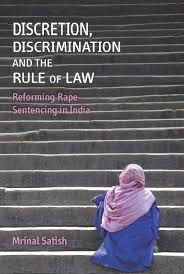
Title: Discretion Discrimination and the Rule of Law; Author: Mrinal Satish; Publisher: Cambridge University Press; Pages: 310; Price: Rs 695
Even with stringent laws in place to deter sexual violence against women inconsistencies in the judicial process many a time leads to lighter punishment for the perpetrators. Often women are judged by their past sexual history -- whether she had been sexually active or she was in acquaintance with the accused. Lawyer and academician Mrinal Satish s book Discretion Discrimination and the Rule of Law: Reforming Rape Sentencing in India examines the rape sentencing regime in India to tell us why the judiciary needs sentencing guidelines. The well-researched book throws light on the rape sentencing pattern in India by examining about 800 cases decided by the Supreme Court of India and 21 High Courts over a quarter of a century -- between 1984 and 2009. The author argues that rape adjudication in India has always been impacted by pre-conceived notions myths and stereotypes about the offence and about victims of rape. Rape myths -- such as absence of injury indicates consent during intercourse; or rape by a stranger is necessarily more traumatic than by an acquaintance -- are prime factors considered in rape sentencing the author says. Satish s book narrates various examples to convey to readers that a higher sentence is given to convicts for aking away the virginity of a chaste woman. He says this stems from stereotypes prevailing in the country which consider virginity to be of utmost importance to a woman. He gives an example of a Supreme Court case where it opined that an unmarried woman would not falsely allege rape because that would hamper her prospects of finding a match in a espectable or acceptable family. In Madan Gopal Kakkad vs. Naval Dubey the Supreme Court noted the pitiable state of the victim and observed: (the victim) having lost her virginity still remains unmarried... (she) is under the impression that there is no monsoon season in her life and that her future chances for getting married and settling down in respectable family is completely marred. The book says that courts often take into consideration various factors which are not related to law or even the facts of the case but on the personal philosophy of the sentencing judge. His analysis shows that presence of injuries on victim or violence lead to increased sentence and their absence translates to consent of victim and on-injuries rapes are not really violent crimes. The book also takes a look at the consideration of mitigating factors by courts while sentencing the offenders. For instance in a case where a six-year-old-girl was raped by a man the judge let him free considering that he was suffering from tuberculosis and was 65 per cent paralysed in his left limbs. The judge said since ature has punished him enough a custodial sentence of 23 days (which he had already spent during pre-trial detention) would be sufficient. The inconsistent application of mitigating factors is a major cause for unwarranted disparity in sentencing and also raises issues of fairness. It amounts to an arbitrary exercise of judicial discretion which could lead to the entire sentencing system being unconstitutional says the author. In order to do away with such disparity in punishment in rape cases the book suggests formulation of sentencing guidelines for court that detail factors that should and should not be considered while sentencing to ensure principled sentencing by courts. Read the book if you are looking for well-researched and in-depth knowledge on sentencing patterns in rape cases by Indian courts. The book will definitely benefit its readers -- specially law students law researchers lawyers and even the general public. Satish an associate professor at the National Law University Delhi assisted the Justice J.S. Verma Committee that was set up in the immediate aftermath of the December 16 2012 gang-rape in Delhi to review the laws and suggest amendments. --IANS gt/vm/sac