SC refuses to stay Madras HC order on Thiruparankundram Deepam
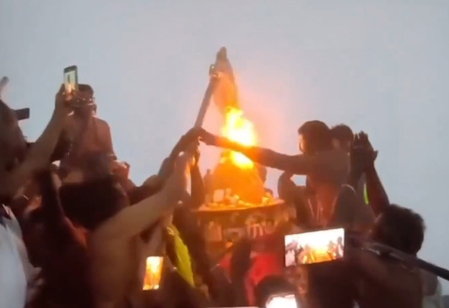
New Delhi, Aug 3 (IANS) The Supreme Court on Monday issued notice on a plea filed by the Tamil Nadu government challenging a Madras High Court order permitting the lighting of the traditional Karthigai Deepam at the 'deepa thoon' (lamp pillar) situated atop the Thiruparankundram hill near a dargah in Madurai district.
A Bench of Justices Aravind Kumar and Vipul M. Pancholi sought responses from the original writ petitioners before the Madras High Court and other respondents and tagged the matter with a connected pending case for further hearing.
However, the apex court declined the state government's request for an ex parte stay on the operation of the Madras High Court's order and merely issued notice on the stay application.
During the hearing, the Justice Kumar-led Bench questioned the delay in approaching the apex court, asking why the Tamil Nadu government had filed the petition only in June against a High Court order passed in January.
The state government's special leave petition (SLP) was filed on June 11, shortly after the new government led by Chief Minister C. Joseph Vijay assumed office.
The Supreme Court ordered that the SLP be tagged with a pending writ petition filed by the Hindu Dharma Parishad seeking an Archaeological Survey of India (ASI) takeover of the Thiruparankundram hill and directions for daily lighting of the lamp at the disputed spot.
The dispute relates to the lighting of the traditional Karthigai Deepam at a stone pillar, known as the 'deepa thoon', located near a dargah atop the historic Thiruparankundram hill, a site that houses the famed Arulmigu Subramaniya Swamy Temple as well as a dargah near its summit.
Earlier this year, the Madras High Court's Madurai Bench had partly upheld an earlier order passed by single-judge Justice G.R. Swaminathan, permitting the temple administration to light the Karthigai Deepam at the stone pillar atop the hill in addition to the customary locations where the ritual is traditionally observed.
The High Court had rejected the state government's contention that permitting the ceremony near the dargah could trigger communal tensions and disturb public order.
In its judgment, the single judge had described the authorities' apprehensions as an "imaginary ghost" and questioned why a government vested with extensive administrative and policing powers would be unable to maintain peace during a religious event conducted on temple land.
The High Court had observed that allowing a limited number of temple representatives to light a ceremonial lamp at the designated stone pillar on a single day each year could not be regarded as an unmanageable law and order exercise.
It had also cautioned the state government against pursuing any political agenda through such objections and stressed that ensuring peaceful worship formed part of the state's constitutional responsibility.
--IANS
pds/dpb
Disclaimer: This post has been auto published from IANS news agency without any modifications.