Vast wave of hot gas found in nearby Perseus galaxy cluster
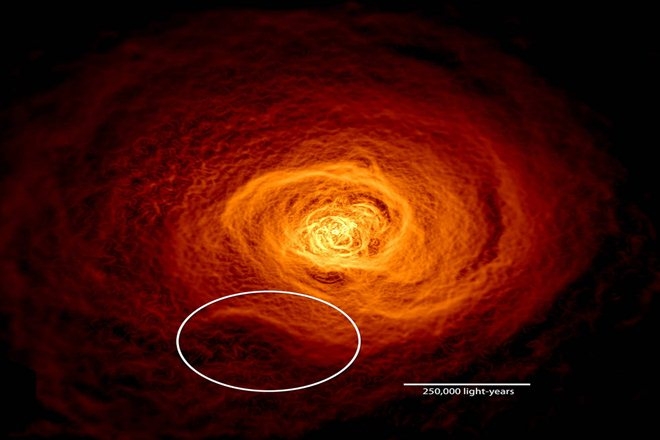
Washington May 3 (IANS) An international team of scientists has discovered a vast wave of hot gas in the nearby Perseus galaxy cluster.
Spanning some 200 000 light-years the wave is about twice the size of our own Milky Way galaxy according to a study published online in the journal Monthly Notices of the Royal Astronomical Society.
For the study the researchers combined data from NASA s Chandra X-ray Observatory with radio observations and computer simulations.
The wave formed billions of years ago after a small galaxy cluster grazed Perseus and caused its vast supply of gas to slosh around an enormous volume of space the researchers said.
Perseus is one of the most massive nearby clusters and the brightest one in X-rays so Chandra data provide us with unparalleled detail said lead scientist Stephen Walker at NASA s Goddard Space Flight Centre in Greenbelt Maryland.
The wave we ve identified is associated with the flyby of a smaller cluster which shows that the merger activity that produced these giant structures is still ongoing Walker said.
Galaxy clusters are the largest structures bound by gravity in the universe today.
Some 11 million light-years across and located about 240 million light-years away the Perseus galaxy cluster is named for its host constellation.
Like all galaxy clusters most of its observable matter takes the form of a pervasive gas averaging tens of millions of degrees so hot it only glows in X-rays.
Chandra observations revealed a variety of structures in this gas from vast bubbles blown by the supermassive black hole in the cluster s central galaxy NGC 1275 to an enigmatic concave feature known as the bay.
--IANS
gb/in