Thought-controlled musical instrument may help stroke patients
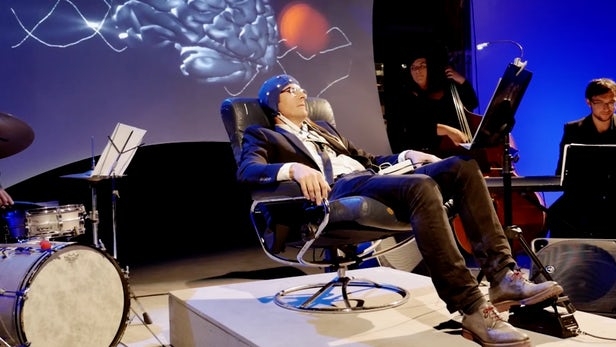
Washington July 13 (IANS) Neurologists have created a hands-free thought-controlled musical instrument they hope will help empower and rehabilitate patients with motor disabilities such as those from stroke spinal cord injury or amputation.
"There is great potential for the Encephalophone to hopefully improve rehabilitation of stroke patients and those with motor disabilities " Deuel says.
"The Encephalophone is a musical instrument that you control with your thoughts without movement " explained Thomas Deuel a neuroscientist at the University of Washington and first author of a study detailed in the journal Frontiers in Human Neuroscience.
"There is great potential for the Encephalophone to hopefully improve rehabilitation of stroke patients and those with motor disabilities " Deuel said.
The Encephalophone collects brain signals through a cap that transforms specific signals into musical notes.
The invention is coupled with a synthesiser allowing the user to create music using a wide variety of instrumental sounds.
In an experiment the researchers found that participants were able to use the instrument to correctly recreate musical tones with no prior training.
The Encephalophone can be controlled via two independent types of brain signals -- either those associated with the visual cortex (closing one s eyes) or those associated with thinking about movement.
The researchers found that control by eye closing was more accurate than control by imagining movements.
Control by thinking about movement may be the most useful for disabled patients and Deuel plans to continue researching this application.
The Encephalophone is based on brain-computer interfaces using an old method called electroencephalography which measures electrical signals in the brain.
--IANS
gb/vm