MP, a land of chaotic traffic
Saturday - December 15, 2018 9:31 am ,
Category : WTN SPECIAL
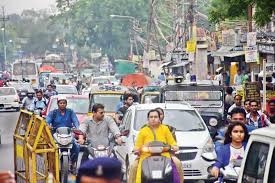
WTN- Madhya Pradesh is a land of growing prosperity and hope. But one area where we fare badly is traffic management. Despite phenomenal growth in road network in the state over the last decade, MP also has the dubious distinction of registering one of the highest numbers of road accidents and fatalities in the country, that too when the per capita vehicular number in MP is still far lower than some of the other developed states which have a much better traffic record.
Though this largely falls on the administration and the government to ensure proper traffic management that could lessen accidents, the onus also falls on people’s traffic sense and driving habits. MP, being what it is, has comparatively lesser awareness in the people in following traffic norms and they hazard risky driving.
Breaking signals is the most common manifestation of this propensity. Speeding, carrying people/goods beyond capacity, using poor old tyres, improper upkeep of vehicles, talking on phone while driving, parking at odd places that block traffic, turning without switching on the indicators, riding without helmet, driving without seatbelt etc. are some of the widely prevalent practices that people are reluctant to shun.
This also relates to poor policing but it must be admitted that unless people cooperate the police cannot do anything alone. We all know that the police are understaffed and under immense pressure— they simply cannot be present everywhere and it is naïve to heap every blame of our faults on police inaction.
Random checks they can do and they do it and even fine for violations. But this is not working. The number of vehicles is rising by leaps and bounds. In foreign countries violations are rare because people have the prudence to follow the rules. They don’t need the police baton over their heads. In India the case is different. If people are not concerned about their own lives and are ready to dig their own graves, no one can help them.
A little more awareness campaigns by the government can be welcome, but the immediate outcome is doubtful still, because those who violate traffic rules are mostly not those who are unaware of them. It is a tendency people have grown up with and it has so much become a part of their character that they break rules by a reflexive action without thought. The way out is perhaps educating children so that they pick the drift early on and internalise it better.
If instilled from childhood, at the time of character formation, many good habits can be inculcated much easily. Children are natural force multipliers because they can insist and influence elders. Our school syllabuses must carry chapters on traffic rules, how and why they are violated and how we can make our and others’ life safer on the road by following some simple rules.
Children grow up into elders, and if they grow up as responsible and conscious citizens, our society can be better and a new trend can be established which then passes on through generations. This is the way we can evolve. In any case this is a more productive and civilised way than continual police hounding to make us behave, which succeeds only temporarily. We are so used to be guided and forced by the police that we have forgotten to be responsible for our own actions. This must change. – Window To News
Though this largely falls on the administration and the government to ensure proper traffic management that could lessen accidents, the onus also falls on people’s traffic sense and driving habits. MP, being what it is, has comparatively lesser awareness in the people in following traffic norms and they hazard risky driving.
Breaking signals is the most common manifestation of this propensity. Speeding, carrying people/goods beyond capacity, using poor old tyres, improper upkeep of vehicles, talking on phone while driving, parking at odd places that block traffic, turning without switching on the indicators, riding without helmet, driving without seatbelt etc. are some of the widely prevalent practices that people are reluctant to shun.
This also relates to poor policing but it must be admitted that unless people cooperate the police cannot do anything alone. We all know that the police are understaffed and under immense pressure— they simply cannot be present everywhere and it is naïve to heap every blame of our faults on police inaction.
Random checks they can do and they do it and even fine for violations. But this is not working. The number of vehicles is rising by leaps and bounds. In foreign countries violations are rare because people have the prudence to follow the rules. They don’t need the police baton over their heads. In India the case is different. If people are not concerned about their own lives and are ready to dig their own graves, no one can help them.
A little more awareness campaigns by the government can be welcome, but the immediate outcome is doubtful still, because those who violate traffic rules are mostly not those who are unaware of them. It is a tendency people have grown up with and it has so much become a part of their character that they break rules by a reflexive action without thought. The way out is perhaps educating children so that they pick the drift early on and internalise it better.
If instilled from childhood, at the time of character formation, many good habits can be inculcated much easily. Children are natural force multipliers because they can insist and influence elders. Our school syllabuses must carry chapters on traffic rules, how and why they are violated and how we can make our and others’ life safer on the road by following some simple rules.
Children grow up into elders, and if they grow up as responsible and conscious citizens, our society can be better and a new trend can be established which then passes on through generations. This is the way we can evolve. In any case this is a more productive and civilised way than continual police hounding to make us behave, which succeeds only temporarily. We are so used to be guided and forced by the police that we have forgotten to be responsible for our own actions. This must change. – Window To News