Primitive and Provincial practice says PETA
Monday - February 27, 2017 4:25 pm ,
Category : WTN SPECIAL

The Jallikattu storm that ravaged Tamil Nadu politics and society and raised quite a stir across party and cultural lines throw up an occasion for a serious debate on the force of societal beliefs versus the strength of logic and reasoning. The Supreme Court had to bow down to the mob obsession even as the TN state government promulgated an ordinance legalising the cruel practice overturning the SC stay. It is certainly disturbing to see the bulls tormented in violent passion for people’s pleasure, which belies ethics.
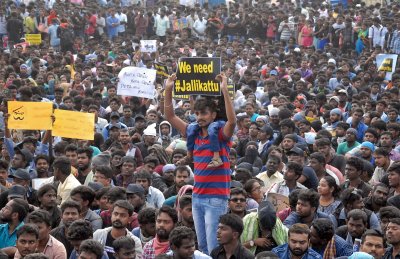 No matter what the pro-Jallikattu brigade says in favour of the two-thousand-year-old practice, it is without a doubt that the action falls under the purview of the Prevention of Cruelty to Animals Act because of the very nature of the ‘game’. The animals are often fed intoxicants to excite them, the tail is bitten off and/or twisted hard that poses danger to their vertebra, and then they are provoked, beaten up, pushed and shoved and in nervous derangement they run amok, often injuring themselves in the melee even as the fighters vie for hanging on to their hump and taming them. This is a primitive and provincial practice that has only gained currency and popularity with media spread and skewed notions of cultural pride and the modern law of the land, that prohibits cruelty to animals, must have come in force. But the stir was getting violent and the support overwhelming, forcing the dispensations to re-think the move. A move that spreads tension and violence cannot be good for society either. Tamils in large numbers are emotionally attached to Jallikattu and any ban on it was being seen as an onslaught and insult on their socio-cultural motif. The performers and advocates of the sport have expounded very logically the various steps associated with the breeding and rearing of the studs and their judicious and calculated use in the game, claiming that the injuries are minimal to the animals or the players. They say the animals are inured to this social function of centuries and they perfectly know how to safely play it out.
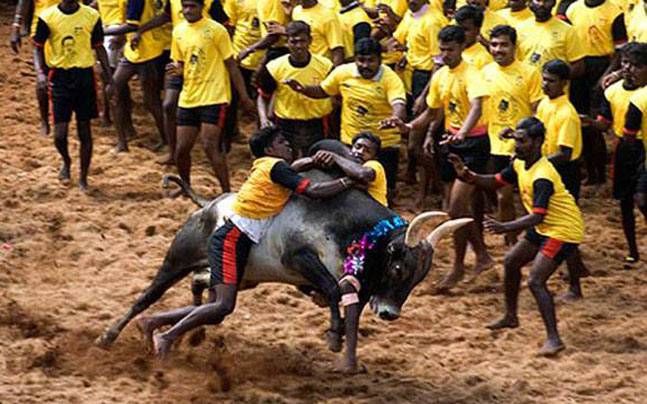 Further, they also say the practice is so intricately entwined with the collective psychology of the Tamil people, that they cannot accept the Pongal celebrations complete without having Jallikattu as a part of it. It is very difficult for the outside world to really gauge the impact of banning a practice, on the culture that celebrates it. There may be some iota of truth in what the promoters and practitioners of Jallikattu claim but we have no way to verify if the bulls really enjoy the stunt. It is apparently cruel to force a living thing to do something that doesn’t come naturally to it. It is clear that they are hardly their normal self when they are raging in the arena. They fret and gore around, seem irked, desperate and dazing, oftentimes ending up with an injured foot or a broken horn even as people soak in the revelry in all good spirit. Man has always tried to tame the wild for his convenience and pleasure. But we need to draw the line somewhere between cruelty and entertainment. We need to moderate the intensity so that the risks are minimised and the signs of cruelty are not so telling. But is it possible when passions are volatile and emotions fragile?
No matter what the pro-Jallikattu brigade says in favour of the two-thousand-year-old practice, it is without a doubt that the action falls under the purview of the Prevention of Cruelty to Animals Act because of the very nature of the ‘game’. The animals are often fed intoxicants to excite them, the tail is bitten off and/or twisted hard that poses danger to their vertebra, and then they are provoked, beaten up, pushed and shoved and in nervous derangement they run amok, often injuring themselves in the melee even as the fighters vie for hanging on to their hump and taming them. This is a primitive and provincial practice that has only gained currency and popularity with media spread and skewed notions of cultural pride and the modern law of the land, that prohibits cruelty to animals, must have come in force. But the stir was getting violent and the support overwhelming, forcing the dispensations to re-think the move. A move that spreads tension and violence cannot be good for society either. Tamils in large numbers are emotionally attached to Jallikattu and any ban on it was being seen as an onslaught and insult on their socio-cultural motif. The performers and advocates of the sport have expounded very logically the various steps associated with the breeding and rearing of the studs and their judicious and calculated use in the game, claiming that the injuries are minimal to the animals or the players. They say the animals are inured to this social function of centuries and they perfectly know how to safely play it out.Further, they also say the practice is so intricately entwined with the collective psychology of the Tamil people, that they cannot accept the Pongal celebrations complete without having Jallikattu as a part of it. It is very difficult for the outside world to really gauge the impact of banning a practice, on the culture that celebrates it. There may be some iota of truth in what the promoters and practitioners of Jallikattu claim but we have no way to verify if the bulls really enjoy the stunt. It is apparently cruel to force a living thing to do something that doesn’t come naturally to it. It is clear that they are hardly their normal self when they are raging in the arena. They fret and gore around, seem irked, desperate and dazing, oftentimes ending up with an injured foot or a broken horn even as people soak in the revelry in all good spirit. Man has always tried to tame the wild for his convenience and pleasure. But we need to draw the line somewhere between cruelty and entertainment. We need to moderate the intensity so that the risks are minimised and the signs of cruelty are not so telling. But is it possible when passions are volatile and emotions fragile?