Toilet Day is significant for India
Friday - November 22, 2019 10:59 am ,
Category : WTN SPECIAL
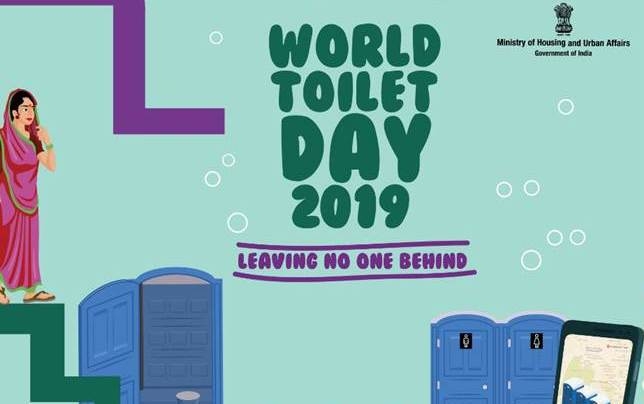
WTN- India along with many other countries of the world observed World Toilet Day on November 19. The Day is an official United Nations international observance day on November 19 to inspire action to tackle the global sanitation crisis. Worldwide, 4.2 billion people live without "safely managed sanitation" and around 673 million people practise open defecation. Sustainable Development Goal 6 (Sustainable Development Goal 6 is one of 17 Sustainable Development Goals established by the United Nations General Assembly in 2015. It calls for clean water and sanitation for all people) aims to achieve sanitation for all and end open defecation.
World Toilet Day exists to inform, engage and inspire people to take action toward achieving this goal. Good health, clean water and sanitation services continue to be priorities for India too. The health concerns and well-being are closely linked to that of an adequate water supply and functional sanitation systems. Lack of sanitation facilities contributes to about 10 per cent of the global diseases, causing diarrheal infections that kill thousands of children in India as in many other countries of the developing world. In India, one of the major sanitary concerns has been open defecation, which is root cause for multiple health hazards.
Due to government initiative, the country has constructed 12 million toilets in the last five years. Lakhs of villages in the country have been declared open defecation free, saving and safeguarding the lives of millions. Yet, the major task ahead is to keep the momentum up and sustain the initiative so that safe sanitary practices become a norm with the people. There are still toilets which are running short of water; there are still toilets which have lost their roof or a portion of the wall or the tap and fallen into disuse for these reasons.
Proper funding, upkeep and monitoring of the toilets need to be ensured so that people don’t go back into the habit of open defecation. The importance of a covered toilet at home and healthy and hygienic sanitation practices have newly been introduced in the people in a big way and it takes time for a new concept to percolate down to the last man so that it becomes a national culture to adopt seamlessly. For that the initial impetus has to be maintained at any cost over a period of time till the new habits become a part of the cultural mores. Here is where the government’s success will mainly count because if the whole programme becomes a temporal affair, and we slump back to the old habits then the gains made will stand negated in time.
Also, efforts must be made to open more public toilets in cities where there is major accumulation and movement of humanity. Many of them have been opened, but the Indian urban scape is still starved of public conveniences and we need many more safe, hygienic and facilitated toilets to cater to the needs of commuters. Many of the toilets initially opened are today examples of neglect and disinterest as they are stinking and running without water.
We must tackle this pitfall effectively, as this is a traditional drawback in our management of public facilities. We need to make the toilet initiative much more a real tool of empowerment than just what the hype surrounding it portrays.- Window To News
World Toilet Day exists to inform, engage and inspire people to take action toward achieving this goal. Good health, clean water and sanitation services continue to be priorities for India too. The health concerns and well-being are closely linked to that of an adequate water supply and functional sanitation systems. Lack of sanitation facilities contributes to about 10 per cent of the global diseases, causing diarrheal infections that kill thousands of children in India as in many other countries of the developing world. In India, one of the major sanitary concerns has been open defecation, which is root cause for multiple health hazards.
Due to government initiative, the country has constructed 12 million toilets in the last five years. Lakhs of villages in the country have been declared open defecation free, saving and safeguarding the lives of millions. Yet, the major task ahead is to keep the momentum up and sustain the initiative so that safe sanitary practices become a norm with the people. There are still toilets which are running short of water; there are still toilets which have lost their roof or a portion of the wall or the tap and fallen into disuse for these reasons.
Proper funding, upkeep and monitoring of the toilets need to be ensured so that people don’t go back into the habit of open defecation. The importance of a covered toilet at home and healthy and hygienic sanitation practices have newly been introduced in the people in a big way and it takes time for a new concept to percolate down to the last man so that it becomes a national culture to adopt seamlessly. For that the initial impetus has to be maintained at any cost over a period of time till the new habits become a part of the cultural mores. Here is where the government’s success will mainly count because if the whole programme becomes a temporal affair, and we slump back to the old habits then the gains made will stand negated in time.
Also, efforts must be made to open more public toilets in cities where there is major accumulation and movement of humanity. Many of them have been opened, but the Indian urban scape is still starved of public conveniences and we need many more safe, hygienic and facilitated toilets to cater to the needs of commuters. Many of the toilets initially opened are today examples of neglect and disinterest as they are stinking and running without water.
We must tackle this pitfall effectively, as this is a traditional drawback in our management of public facilities. We need to make the toilet initiative much more a real tool of empowerment than just what the hype surrounding it portrays.- Window To News