So the world population to start decreasing after 2064 due to 'these reasons'
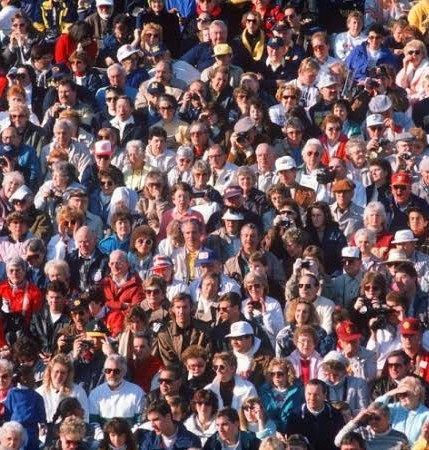
World population to be less than 2 billion by estimates in the year 2100
JULY 18 (WTN) - One major cause of many problems of many poor and developing countries is the overpopulation of those countries. As far as India is concerned, the vast population of the country is largely responsible for many other problems, including unemployment. However, governments of many countries ,including India, are making considerable efforts for population control. But unti, concrete success cannot be achieved in this direction, unless the public is aware.
But, if we tell you that after 2064, the world population will start decreasing, then you must have been surprised to read this. But you don't have to be shocked. In fact, new research has claimed that from 2064 onwards, the world population will start decreasing. At the same time, research has said that by the coming of the 22nd century, the world population will be less by two billion than expected.
For your information, let's know that this research on the world population has been done by the researchers of the Institute of Health Matrix and Evaluation (IHME) at Washington's School of Medicine University. According to this research, in the coming time, the change of population will also affect the balance of power and economy of the world. According to this study published in The Lecent in March this year, the world population was 7.8 billion. But in 2064, it will reach the highest at 9.7 billion.
But after the world's highest population in 2064, a big change will be seen. In fact, with the increase in the use of contraceptive devices and the girls becoming more educated and aware, the fertility rate will start to decrease gradually. And for this reason, by the turn of the 22nd century, the world's population will be less by two billion than expected.
Explain that in this study, the new method predicted mortality, fertility, and migration and the data of the Global Burden of the Disease Study-2017 were also used. And based on all this, they have estimated the future global, regional, and national population.
According to this research, by the year 2100, the total fertility rate in 183 out of 195 countries will be less than the replacement level of 2.1. For your information, let's know that the total fertility rate is the average number of children a woman has born in her life. That is, in the coming time, fewer children will be given birth by women which will reduce the population of many countries.
Naturally, due to the decrease in the population, many countries will face a shortage in the workforce. Not only this, but it will also have a major impact on the health and social system. Now, while the population of some countries will decrease, it will also have a major impact on the global balance of power. At the same time, due to the dwindling population and its impact on the working population, many countries will have to adopt a liberal view in their migrant policies. Because the working population decreases, the GDP of many countries will make a big difference. And because of this, there can be a big change in the global economic powers.
Indeed, the entire estimates of this study are based on the decreasing total fertility rate (TFR). Explain that the world's TFR was 2.37 in the year 2017. But in 2100, TFR will be reduced to only 1.66. This change is much lower than the normal fertility rate of 2.1, which must be in order to sustain a population. It is clear that the population of most countries of the world will start to decrease with the fertility rate falling from 2.1 to 1.7.
However, only the areas of North Africa and the Middle East will be such that the population will be more than the population of 2017 in the year 2100. At the same time, the population of Asia and East and Central Europe can see a decline of 25 to 50 percent. But as far as India is concerned, India's population will be reduced to only around 25 percent. Now, many countries, including India, are lagging behind in the race for development due to the burden of population, it is to be hoped that by the year 2100, India's fast growing population will be controlled to a great extent.