
Dotara became popular amongst visitors
Wednesday - November 22, 2017 8:15 pm ,
Category : BHOPAL
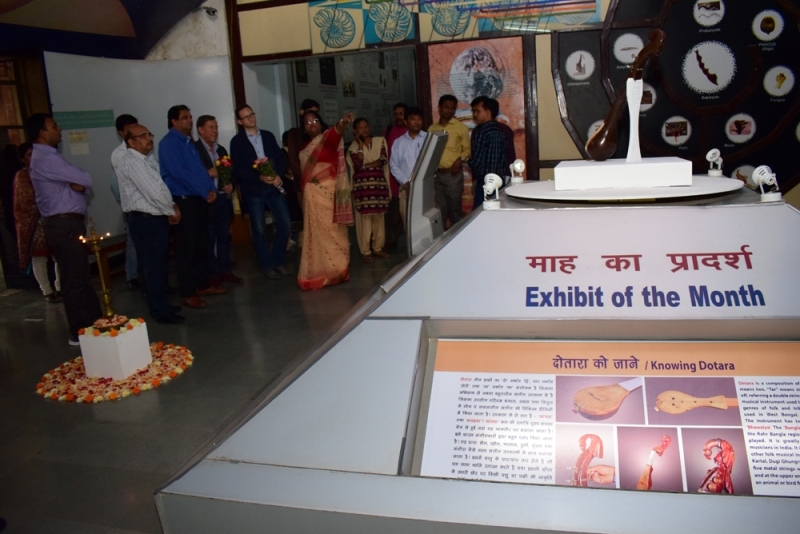
Bhopal: Under the popular museum series 'Exhibit of the Month' of Indira Gandhi Rashtriya Manav Sangrahalaya, a traditional object is displayed in the appearance for a whole month. The exhibit for the month of November, 2017 is "Dotara". Dotara, a plucked string instrument from folk community of Birbhum district, West Bengal constitutes to be an indispensable instrument of the folk music of West Bengal. It largely occupies a predominant place in the Baul Sangeet of the state. The instrument is also connected with distinct names by different ethnic communities in different regions.
Dotara plays an important role to keep the culture and tradition alive. It embodies the musical traditions of different regional cultures which is well reflected in the tribal and folk performances of Baul, Bhawaiya, Kamrupee, Goalpariya in eastern and north eastern parts of India. Apart from these, Dotara also occupies an important role in the devotional music, rituals, dances and other socio religious activities of the folk people specially the Baul singers who are very much popular in this frontier.
Dotara is made out of various species of hard wood such as Neem, Gamar and jackfruit etc. It has round resonator tapering to the narrow neck and reinforced with a peg box which is intricately carved into the shape of a bird or animal pattern. The resonator is covered with a stretched animal skin. It has a bridge which is made of different material. The strings are tying directly to the base of the instrument.-Windowtonews
Dotara plays an important role to keep the culture and tradition alive. It embodies the musical traditions of different regional cultures which is well reflected in the tribal and folk performances of Baul, Bhawaiya, Kamrupee, Goalpariya in eastern and north eastern parts of India. Apart from these, Dotara also occupies an important role in the devotional music, rituals, dances and other socio religious activities of the folk people specially the Baul singers who are very much popular in this frontier.
Dotara is made out of various species of hard wood such as Neem, Gamar and jackfruit etc. It has round resonator tapering to the narrow neck and reinforced with a peg box which is intricately carved into the shape of a bird or animal pattern. The resonator is covered with a stretched animal skin. It has a bridge which is made of different material. The strings are tying directly to the base of the instrument.-Windowtonews


