
IGRMS organised another chapter of its popular series, Curatorial Talk today
Friday - August 24, 2018 7:29 pm ,
Category : BHOPAL
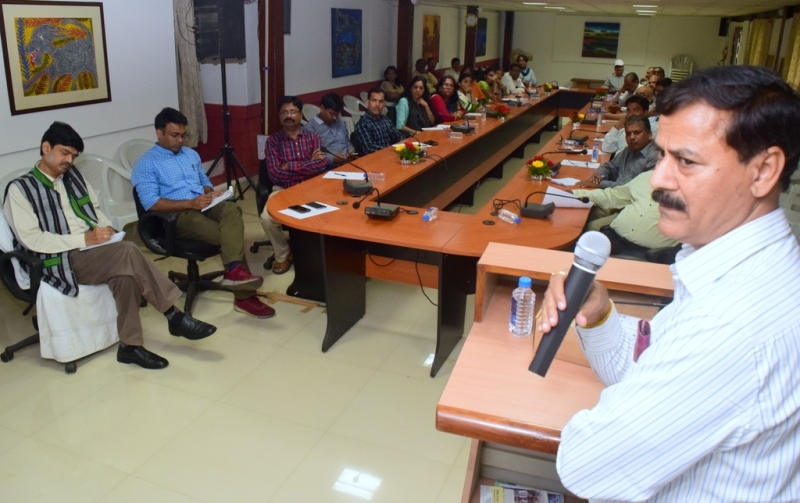
Bhopal: Indira Gandhi Rashtriya Manav Sangrahalaya organised another chapter of its popular series, Curatorial Talk today, where assistant curator of Manav Sangrahalaya, Shri. Rakesh Bhatt. spoke on " Nomadic Life of the Rabaris of Kutch ,Gujrat : A field observation". The lecture was chaired by Prof. Sarit Kumar Chaudhuri, Director, IGRMS. Earlier, Dr. R.M. Nayal, Assistant Keeper gave brief profile of the keynote speaker. The Vote of Thanks was presented by Arun Kiro, Asst. Curator, IGRMS. During collection and documentation (both textual and audio-visual) of their material culture of Rabaris, Tapas Biswas, Photographic Officer and HBS Parihar, Cameraman was also a part of IGRMS team".
In reference of the field work done by them on the Rabari tribes living in the state of Gujrat, Rakesh Bhatt said that the life of western area of Gujarat is full of struggle. At the one end there is only Salt and on the other side there is having a lot of wet mud. But even of these natural problems, the Rabaris of Gujarat has find their place in the big area of about 44000 km. While discussing the extensive documentation and collection of specimens by Shri Bhatt, he informed that these specimens are playing an important role in displaying the life and culture of Rabaris. He added that the life of this nomadic community is having science in it. He also displayed the life, culture and exhibition making activities of Rabari through slide show presentation. The presentation was started with map of India showing temporary residential areas of nomadic communities. It also shows that these communities are moving from here and there for whole year. The life of Rabaris was fully dependent on cattles. In other words, these cattles (Camel, Buffalos, cow, sheep, and goats) are part and parcel of their life. The Rabari women are expert in the traditional embroidery. It is an essential part of their dress. Their knitted and crafted dress and ornaments are displaying in museums exhibition. They also love music.
The Rabaris are enjoying their life with nature for a long time. They can be called as environmentalist because they are not only trying to develop the indigenous techniques of preservation of environment, flora and fauna of India. They can treat themselves from herbs available in forest free of cost. They are self dependent. Even though, their science and culture are stilling on the stage of vanishing.
The IGRMS has collected the information, art and cultural objects associated to their daily life. A film "Rabari" made by IGRMS was also screened on this occasion.-Window To News
In reference of the field work done by them on the Rabari tribes living in the state of Gujrat, Rakesh Bhatt said that the life of western area of Gujarat is full of struggle. At the one end there is only Salt and on the other side there is having a lot of wet mud. But even of these natural problems, the Rabaris of Gujarat has find their place in the big area of about 44000 km. While discussing the extensive documentation and collection of specimens by Shri Bhatt, he informed that these specimens are playing an important role in displaying the life and culture of Rabaris. He added that the life of this nomadic community is having science in it. He also displayed the life, culture and exhibition making activities of Rabari through slide show presentation. The presentation was started with map of India showing temporary residential areas of nomadic communities. It also shows that these communities are moving from here and there for whole year. The life of Rabaris was fully dependent on cattles. In other words, these cattles (Camel, Buffalos, cow, sheep, and goats) are part and parcel of their life. The Rabari women are expert in the traditional embroidery. It is an essential part of their dress. Their knitted and crafted dress and ornaments are displaying in museums exhibition. They also love music.
The Rabaris are enjoying their life with nature for a long time. They can be called as environmentalist because they are not only trying to develop the indigenous techniques of preservation of environment, flora and fauna of India. They can treat themselves from herbs available in forest free of cost. They are self dependent. Even though, their science and culture are stilling on the stage of vanishing.
The IGRMS has collected the information, art and cultural objects associated to their daily life. A film "Rabari" made by IGRMS was also screened on this occasion.-Window To News


