
Bogre became popular amongst visitors
Sunday - December 23, 2018 8:19 pm ,
Category : BHOPAL
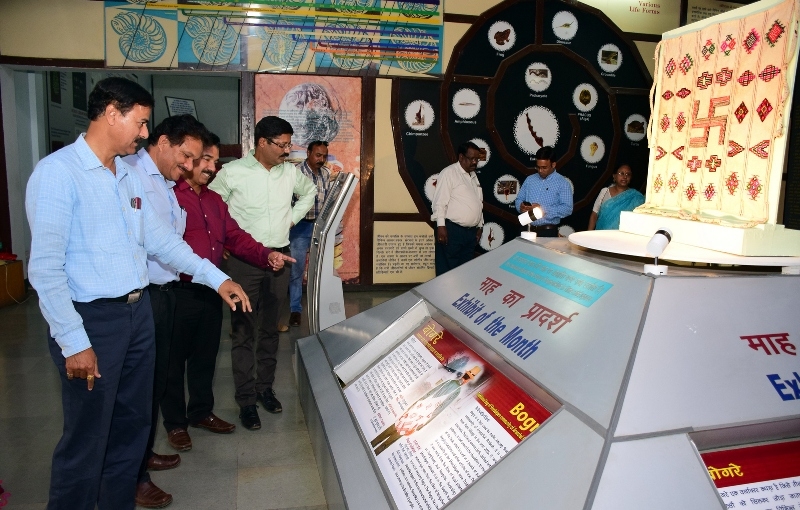
Bhopal: Under the popular museum series 'Exhibit of the Month' of Indira Gandhi Rashtriya Manav Sangrahalaya, a traditional object is displayed in the appearance for a whole month. The exhibit for the month is "Bogre: Traditional bag of Sherdukpen community of Arunchal Pradesh". Bogre is a bag used by males among Sherdukpen community of Arunachal Pradesh. It is collected from Rupa Village in the year 2005. It serves as a knapsack. This hand woven cloth, decked with pretty patterns, is tied around the shoulders to form a fold at the back, which is used as a pouch or pocket for keeping eatables and other articles of use. The Bogre is a speciality of the Sherdukpen area. Traditionally it was made from the fibre of local plants known as hongchong and hongche. According to the Sherdukpen calendar it is in the fourth month that women spin yarn from the fibre of hongchong which is used in weaving Bogre. The Bogre has invariably a Swastika figure in the centre around which variegated patterns are woven. Swastika is a common symbol of luck among the Buddhist people. This exhibition is being mounted by Dr. Surya Kumar Pandey, Assistant Keeper.
Bogre is a square shaped cloth made by joining three equal rectangle pieces stitched together. This woven cloth is prepared on traditional Sherdukpen loom using woolen threads of various colours. The base warp element is white with small linings in black and red strips running uniformly. Intricate designs of extra wefts are produced using strands of pink, black, green, brown and red colours which are significantly arranged in proportion in each halves. Designs represented on the cloth are geometric in pattern. Although the motifs appear similar in forms at an instant sight it characteristically bears distinct woven style and forms. Altogether it carries 14 pairs of designs with a huge Swastika in the middle. A strap of a woven cloth is attached to all the 4 corners of the cloth, the fringe of which are looped in a pattern to give it a shape of rope for tying around the body of user.
Sherdukpen - The Sherdukpen are one of the Buddhist communities of Arunachal Pradesh. They believe that they originated from the marriage of the Tibetan prince with a princess of Assam, possibly of kachari origin. They are mostly distributed in the Shergaon, Rupa, Jigaon and Thungrao villages of the Rupa circle. Their habitat consists of the hilly terrain east of Bhutan and north of the Assam plains. It is situated at an altitude of around 1450 metres above sea level. The area experiences moderate to heavy rainfall and the climate is cool and humid.Their dialect belongs to the greater Tibeto-Burman linguistic family. The Sherdukpens are primarily farmers, and practice both shifting and permanent cultivation. They are expert hunters and use bows and arrows. The Sherdukpens belong to the Lamaistic sect of Tibetan Buddhism. Their Buddhism is blended with local beliefs and shamanism. They observe a number of festivals, the most important being Losar, Chhakar, Wang and Khiksawa .-Window To News
Bogre is a square shaped cloth made by joining three equal rectangle pieces stitched together. This woven cloth is prepared on traditional Sherdukpen loom using woolen threads of various colours. The base warp element is white with small linings in black and red strips running uniformly. Intricate designs of extra wefts are produced using strands of pink, black, green, brown and red colours which are significantly arranged in proportion in each halves. Designs represented on the cloth are geometric in pattern. Although the motifs appear similar in forms at an instant sight it characteristically bears distinct woven style and forms. Altogether it carries 14 pairs of designs with a huge Swastika in the middle. A strap of a woven cloth is attached to all the 4 corners of the cloth, the fringe of which are looped in a pattern to give it a shape of rope for tying around the body of user.
Sherdukpen - The Sherdukpen are one of the Buddhist communities of Arunachal Pradesh. They believe that they originated from the marriage of the Tibetan prince with a princess of Assam, possibly of kachari origin. They are mostly distributed in the Shergaon, Rupa, Jigaon and Thungrao villages of the Rupa circle. Their habitat consists of the hilly terrain east of Bhutan and north of the Assam plains. It is situated at an altitude of around 1450 metres above sea level. The area experiences moderate to heavy rainfall and the climate is cool and humid.Their dialect belongs to the greater Tibeto-Burman linguistic family. The Sherdukpens are primarily farmers, and practice both shifting and permanent cultivation. They are expert hunters and use bows and arrows. The Sherdukpens belong to the Lamaistic sect of Tibetan Buddhism. Their Buddhism is blended with local beliefs and shamanism. They observe a number of festivals, the most important being Losar, Chhakar, Wang and Khiksawa .-Window To News


