
Masher Chakra became popular amongst visitors
Thursday - January 31, 2019 8:56 pm ,
Category : BHOPAL
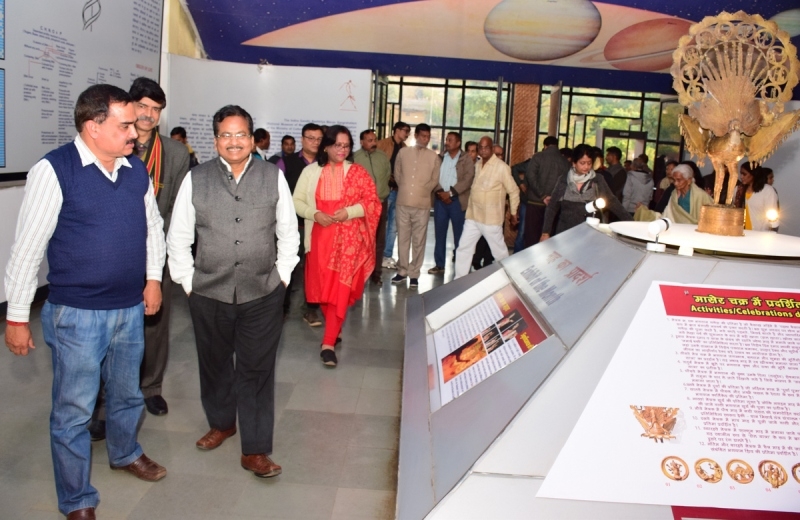
Bhopal: Under the popular museum series 'Exhibit of the Month' of Indira Gandhi Rashtriya Manav Sangrahalaya, a traditional object is displayed in the appearance for a whole month. The exhibit for the monthof January is "Masher Chakra" (A lamp depicting 12 months activities) used in every house of the Karmakar (Dokra) Community from Bikna, Bankura, West Bengal.
'Tamoso – Ma-Jyotir Gamaya' – Signifies the journey from darkness towards light (means the lamp leads us from the darkness towards light. Lamp plays an important role in Hindu rituals. The present object exhibited is a Dokra peacock lamp which is crafted by a community known as Karmakar using lost wax technique. It is a traditional bell metal peacock lamp locally known as 'Masher Chakra', image of a peacock holding a snake on its beak and decorated with five lamps in front and at the top of peacock tail feather, 12 Bengali months celebration/activities are displayed in every round ocellus or eyespot. The peacock is having a bell metal round base with intricate designs. Two wings are also decorated with geometric dokra designs. It is believed that the lamp having five wicks (Panch Deepak) to increase wealth, business and showers akhand aishwariya or wealth to the place. It is collected from Bikna, Bankura, West Bengal in the year 1997. This exhibit of the month has been curetted by Dr. (Smt.) Sudeepa Roy (Assistant Keeper).
Significance of Masher Chakra: – It is a tradition to light a lamp before initiating any kind of auspicious occasions. All ceremonies daily worshiping, religious occasion as well as new ventures start with lighting a lamp which spreads divine grace. Light is a universal symbol of truth, knowledge and understanding. The ancient tradition of lighting lamp brings auspiciousness, prosperity, good health, abundance of wealth. Ghee or oil used in lamp remove vastu faults and bring prosperity in the houses. The present object also fulfilled with all the auspicious symbols meant on it. In West Bengal people celebrates 13 festivals in 12 months known as 'Baro Mashe Taro Parvon'. This bell metal lamp is having symbols of 12 months celebrations on its every ocellus/eyespot on the top of peacock tail feather which are displayed clockwise in the form of 12 Bengali months from Baisakh to Chaitra. (April to March).
Activities/Celebrations displayed in Masher Chakra -
'Tamoso – Ma-Jyotir Gamaya' – Signifies the journey from darkness towards light (means the lamp leads us from the darkness towards light. Lamp plays an important role in Hindu rituals. The present object exhibited is a Dokra peacock lamp which is crafted by a community known as Karmakar using lost wax technique. It is a traditional bell metal peacock lamp locally known as 'Masher Chakra', image of a peacock holding a snake on its beak and decorated with five lamps in front and at the top of peacock tail feather, 12 Bengali months celebration/activities are displayed in every round ocellus or eyespot. The peacock is having a bell metal round base with intricate designs. Two wings are also decorated with geometric dokra designs. It is believed that the lamp having five wicks (Panch Deepak) to increase wealth, business and showers akhand aishwariya or wealth to the place. It is collected from Bikna, Bankura, West Bengal in the year 1997. This exhibit of the month has been curetted by Dr. (Smt.) Sudeepa Roy (Assistant Keeper).
Significance of Masher Chakra: – It is a tradition to light a lamp before initiating any kind of auspicious occasions. All ceremonies daily worshiping, religious occasion as well as new ventures start with lighting a lamp which spreads divine grace. Light is a universal symbol of truth, knowledge and understanding. The ancient tradition of lighting lamp brings auspiciousness, prosperity, good health, abundance of wealth. Ghee or oil used in lamp remove vastu faults and bring prosperity in the houses. The present object also fulfilled with all the auspicious symbols meant on it. In West Bengal people celebrates 13 festivals in 12 months known as 'Baro Mashe Taro Parvon'. This bell metal lamp is having symbols of 12 months celebrations on its every ocellus/eyespot on the top of peacock tail feather which are displayed clockwise in the form of 12 Bengali months from Baisakh to Chaitra. (April to March).
Activities/Celebrations displayed in Masher Chakra -
- The ocellus no. one is having an image of Lord Ganesha which signifies the celebration of Bengali new year known as 'Pahla Baisakh' in the month of Baisakh (April - May). On the auspicious day people worship Lord Ganesha, wear new cloths, distribute sweets and the account book (Hal Khata) is opened by the traders to mark the beginning of the new accounting year.
- Second eyespot is depicted the bonding of 'Son in Law and his mother in law' representing the ceremony 'Jamai Shasthi', celebrated in the month of Jaisthya (May - June). On this special day son-in-law visited his in laws house where a grand celebration organized in his honour by preparing special dishes giving gift and blessed him for a long and prosperous life.
- The third eyespot representing 'Rath Yatra' with the image of Lord Jagannath, Balaram and Subhadra. It is celebrated by pulling a chariot in the month of Ashada (June – July).
- The fourth eyespot depicts the image of Lord Krishna and Radha on swing signifies the celebration of 'Jhulan Yatra' in the month of Shravan (July – August).
- The fifth eyespot represents the image of Lord Krishna carried across the river Yamuna by his father (Vasudeva) under the hood of Sheshnaag, which is celebrated as Janamashtmi in the month of Bhadra (August – September).
- The sixth one represents the image of Durga which is a mark of 'Durga puja' celebration in the month of Ashwin (Sep. – Oct.)
- The seventh eyespot depicts the image of Lord Kartikeya, known as the lord of male fertility and good harvest is worshiped in the month Kartik (Oct. – Nov.).
- The eighth eyespot is represented by an image of sun that signifies the worship of sun god in the month Agrahayan (Nov. – Dec.) known as 'Margashirsha'.
- The ninth one represents the image of operating Dheki – a rice pounding mill signifies the celebration of 'Poush Sankranti' to celebrate the harvest of new crop in the month Poush (Dec. – Jan.).
- The tenth eyespot depicts an image of goddess Saraswati, known as the deity of knowledge is worshiped in the month of Magh (Jan. – Feb.).
- The eleventh eyespot represents the image of Holi festival celebrated in the month of 'Phalgun' (Feb. – March), locally known as 'Dol Yatra' On this occasion people splash each other with colour.
- The last 12th eyespot depicting an image of Lord Shiva associated with the celebration of Gajon and Charak puja in the month 'Chaitra' (March – April).
National Workshop
Indira Gandhi Rashtriya Manav Sangrahalaya, Bhopal is organizing a National workshop on 'Anthropolgy and Museums' from 03rd – 05th February, 2019 (For the Teachers) and 06th to 08th February, 2019 (For the Students). The teachers and students of Anthropology from various Universities are participating in this National Workshop.-Window To News


